
MARKET CONTEXT
Why Defense Needs Different Technology
Defense systems operate under constraints commercial AI solutions never face:
- Sovereignty is non-negotiable: AI infrastructure cannot depend on foreign clouds or foreign vendors.
- Reliability is mission-critical: failures cost lives; every decision must be auditable and deterministic.
- GPS-denial is inevitable: systems must navigate, perceive, and decide when GNSS is jammed or unavailable.
- Real-time performance is required: autonomous platforms operate at speed; latency variance is a tactical disadvantage.
- Low power is essential: UAVs, USVs, and robotic systems have limited battery and require power-efficient computation.
ATLAS solves all of this.
European-owned, deterministic, fully sovereign, low power, mission-ready.
ATLAS for Defense
THREE DEFENSE USE CASES
Use Case 1: Hard Real-Time Autonomous Navigation
Objective: Enable UAVs, AGVs, and USVs to navigate in GPS-denied environments with fault tolerance.
Challenge: GPS jamming is common in contested environments. Standard GNSS-dependent navigation fails. You need inertial-only, vision-only, and visual–inertial fusion navigation — all in hard real time.
Solution
Eagle's navigation stack plus the Hephaestus robotics processor enable real-time perception and localization under any condition combination.
Implementation
- Multi-sensor fusion (inertial + camera + radar).
- Real-time visual odometry (Eagle vision module).
- Path planning and obstacle avoidance (Eagle robotics stack).
- Hephaestus robotics processor for deterministic latency.
- Automatic failover if any sensor fails.
Features
- GPS-denial navigation (guaranteed).
- Sensor fault tolerance (system continues operating).
- Hard real-time performance (deterministic latency).
- On-premises edge computation (zero cloud dependency).
- Full auditability (compliance with defense standards).
Results
- Guaranteed autonomous operation in contested environments.
- System continues safely even if multiple sensors fail.
- Deterministic performance under stress.
- Full sovereignty (no dependency on foreign tech).
Use Case 2: In-Battlefield Secure Federated AI
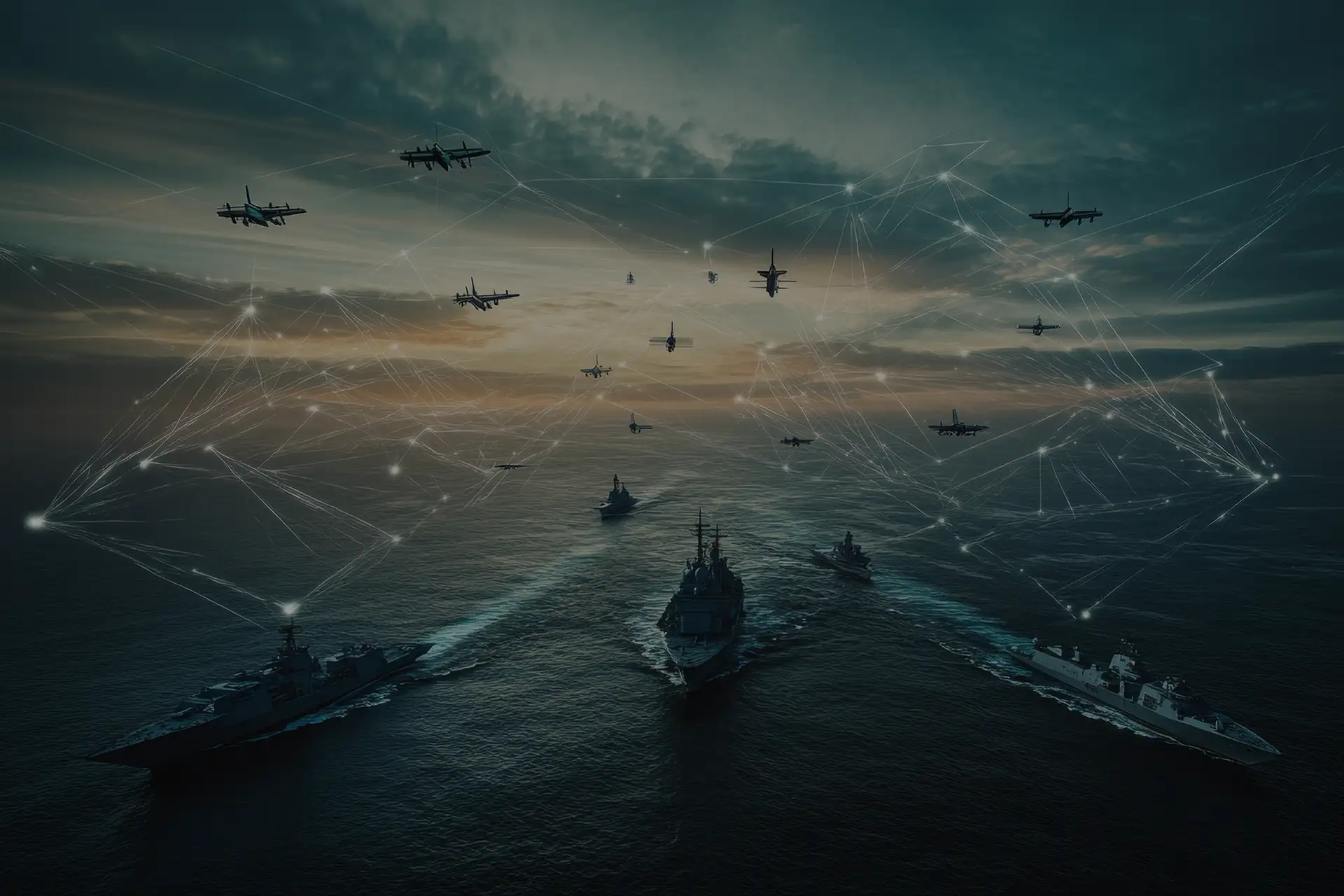
Objective: Enable distributed autonomous systems to learn and share intelligence in real-time without central cloud infrastructure.
Challenge: Battlefield networks are fragmented, low-bandwidth, and subject to jamming. You need distributed learning where small AI models run on each platform, with intelligence shared across the network securely.
Solution
Federated learning powered by ATLAS: each platform runs its own Eagle + Hephaestus instance. Local models infer and train independently, while intelligence is shared securely across the network.
Implementation
- Distributed Eagle libraries on each autonomous platform (UAV, UGV, sensor node).
- Local model training on Hephaestus hardware (no cloud sync).
- Secure model averaging across the network (cryptographically protected).
- Real-time threat detection shared across all platforms.
- Graceful degradation if any network link fails.
Features
- Fully distributed architecture (no central server).
- Secure encryption of model updates.
- Works on fragmented, low-bandwidth networks.
- Continues operating even if links fail.
- Deterministic inference on Hephaestus.
Results
- Collective intelligence from distributed platforms.
- No cloud dependency (security advantage).
- Real-time threat detection network-wide.
- Resilient to network failures.
Use Case 3: In-Satellite Event-Based Visual Odometry
Objective: Enable satellite-based trajectory estimation and orbital mechanics prediction using event-based camera technology.
Challenge: Satellites need to estimate their position relative to stars, other satellites, and celestial bodies. Traditional cameras generate too much data. Event-based cameras, which only output changes, are far more efficient.
Solution
Eagle's vision module optimized for event-based cameras, combined with the Hephaestus inference processor, provides real-time trajectory calculation with deterministic performance.
Implementation
- Event-based camera on the satellite (outputs only pixel changes).
- Real-time visual odometry with Eagle, tracking relative motion to celestial bodies.
- Hephaestus inference for deterministic trajectory estimation.
- On-satellite orbital mechanics calculation (no ground station required).
- Secure communication back to ground with minimal bandwidth.
Features
- Ultra-low data bandwidth (event-based vs. traditional cameras).
- Real-time trajectory estimation.
- Deterministic performance.
- Minimal power consumption (critical for satellites).
- Fully autonomous operation.
Results
- Reduced ground station dependency.
- More accurate orbital tracking.
- Lower bandwidth requirements.
- Energy-efficient computation.
TECHNOLOGY FOR DEFENSE
Why ATLAS Wins for Defense
Sovereignty
- Every component is under your control.
- No foreign cloud. No vendor lock-in.
- You own the technology, data, and models.
Determinism
- Hephaestus delivers the same latency every time.
- No thermal throttling, no variance.
- Mission-critical systems can depend on it.
Resilience & Low Power
- Fault-tolerant architecture, parallel redundancy.
- System continues operating even if components fail.
- 3–5× more efficient than GPU solutions for platforms with limited batteries.
Auditability & Flexibility
- Deterministic, reproducible calculations.
- Full compliance with defense audit and compliance standards.
- Customize to your requirements: inference, training, robotics, all modular.
INTEGRATION WITH DEFENSE ECOSYSTEMS
Works With Your Current Infrastructure
ATLAS tech stack integrates with:
- Sensor systems: Radar, LIDAR, electro-optical, thermal cameras
- Communication: Military-standard networks and protocols
- AI frameworks: PyTorch, TensorFlow (trained off-platform, then deployed)
- Existing platforms: UAVs, UGVs, USVs, space assets, stationary defense infrastructure
You don't replace everything. You enhance your critical decision-making infrastructure.
COMPLIANCE & SECURITY
Defense-Grade Standards
ATLAS tech stack is designed for defense applications:
- Cryptographic security: All communications encrypted
- Deterministic inference: Full traceability of all decisions
- Hardware isolation: No cloud dependencies, no external interference
- Fault tolerance: System continues operating under failure
- Auditability: Complete audit trail of all operations
- European sovereignty: Technology remains under European control