

Why Custom Hardware Matters
Standard GPUs are designed for broad consumer applications. They deliver variable latency, high power consumption, and dependence on external vendors. Mission-critical systems, financial infrastructure, defense systems, medical devices, autonomous robots need something different. They need hardware engineered specifically for their use case. Hardware they control. Hardware that behaves predictably under pressure.
Hephaestus is that hardware.
Deploy immediately on FPGA or build your own ASIC.
TWO CHIP DESIGNS
Hephaestus AI Inference Processor
For: Real-time decision-making in finance, defense, medical, and autonomous systems.
What it does: Runs AI models with deterministic latency (1-100 microseconds, every time). No variance. No surprises.
Key specs:
- Deterministic latency: 1-100 microseconds
- On-premises deployment: no cloud dependency
- Power consumption: 3.5-25W (vs. 40-130W for competitors)
- Reliability: ECC memory, parallel redundancy, fault-tolerant design
- Customizable: balance computational power, chip area, power consumption per your requirements
Ideal for: High-frequency trading, real-time risk systems, medical devices, autonomous navigation, defense applications.
Hephaestus Robotics Processor
For: Industrial robots, collaborative robots, autonomous drones, autonomous ground vehicles, and autonomous underwater vehicles.
What it does: Accelerates vision, perception, and localization functions, offloading computation from the main CPU to achieve real-time performance at minimal power consumption.
Key specs:
- Vision acceleration: real-time perception and semantic segmentation
- Localization acceleration: GPS-denied navigation, visual odometry, inertial navigation
- Low power: extends battery life for mobile robotics and drones
- Modular design: integrate into existing robot architectures
- Customizable: tailor to your specific robotics platform
Ideal for: Industrial automation, collaborative manufacturing, autonomous drones, defense robotics, medical robotics, logistics automation.
CORE SPECIFICATIONS (All Variants)
Deterministic Performance
Every Hephaestus variant delivers predictable latency. No thermal throttling. No cache misses creating variance. No cloud round-trips. Your system behaves the same way in the lab and in production.
On-Premises Deployment All computation happens on your infrastructure. Your data never leaves your premises. Your models run where you control them. No external dependency. No cloud outages affecting your operations.
Fault Tolerance & Reliability ECC-enabled memory detects and corrects errors. Parallel redundancy ensures continuous operation if a subsystem fails. No cold restarts. Your system continues operating safely, even during component failures.
Power Efficiency Hephaestus consumes 3-5x less power than competitor GPUs. For infrastructure running 24/7, this translates to massive OPEX savings over 3-5 years.
Full Customization Every organization's requirements are different. We customize Hephaestus to balance your specific needs: computational capability, chip area, power consumption, temperature profile, and integration requirements.
COMPARISON VS COMPETITORS
Why Hephaestus Wins
| Criteria | Hephaestus | GPU | Cloud AI |
|---|---|---|---|
| Latency | 100ns to 100μs (deterministic) | 1ms - 100ms (variable) | 50-500ms (cloud round-trip) |
| Power | 3.5-25W | 40-130W | Not owned by you |
| Data Sovereignty | On-premises | On-premises | Cloud-dependent |
| Vendor Lock-in | None (you own it) | High (CUDA dependency) | High (cloud platform) |
| OPEX over 5 years | €€€ (lowest) | €€€€ | €€€€€ (continuous cloud costs) |
| Ownership | Design License to you | Limited (software only) | Zero (cloud-only) |
| Customization | Complete | Limited | None |
| Cold-start latency | Deterministic | Variable | Unpredictable |
INTEGRATION & DEPLOYMENT
How Hephaestus Integrates
Hephaestus works alongside your existing infrastructure. Our Eagle software library interfaces seamlessly with:
- AI Frameworks: PyTorch, TensorFlow, JAX
- CPU architectures: x86, ARM, RISC-V
- Deployment environments: On-premises servers, edge devices, embedded systems
- Data pipelines: Standard HDF5, CSV, streaming data interfaces
You don't replace your entire system.
You add Hephaestus where it matters most, where latency, reliability, and sovereignty are non-negotiable.
USE CASES
Where Hephaestus make the difference
Hephaestus in Finance
Volatility forecasting in real-time. Risk system inference during market stress. Trade execution with zero-latency surprises.

Hephaestus in Defense
GPS-denied autonomous navigation. Real-time threat detection. Federated AI across distributed systems. Cryptographically secured AI inference.
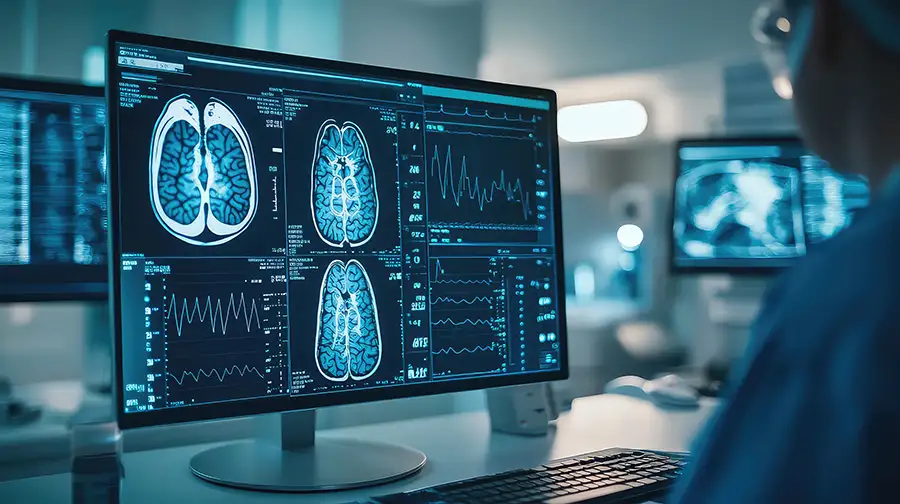
Hephaestus in Medical
Brain-computer interface signal processing. Real-time ultrasound image enhancement. Patient monitoring with sub-millisecond response times.

Hephaestus in Robotics
Real-time vision and perception. Autonomous navigation and obstacle avoidance. Force control and manipulation. Predictive maintenance of mechanical components.